Living in Time: Past, Present, and Future
By Norris Frederick
We human individuals are “the kind of animal whose essence it is to question, create, and love. We are metaphysical animals. We make and share pictures, stories, theories, words, signs and artworks that help us to navigate our lives together. These creations are immensely powerful, because they at once show us what is and was the case, and at the same time suggest new ways of going on.”[1]
— Metaphysical Animals: How Four Women Brought Philosophy Back to Life
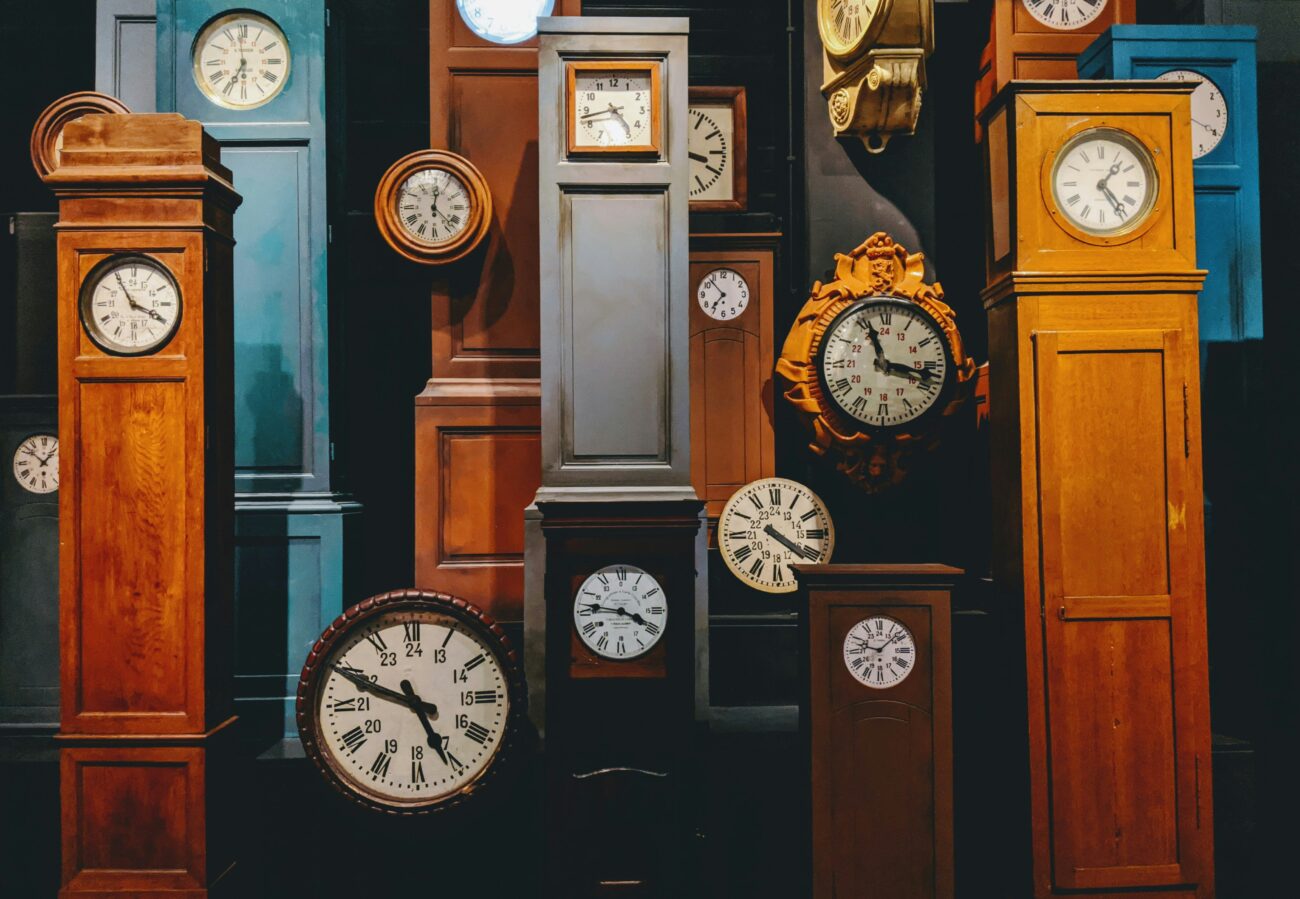
Clocks photo by Lucian Alexe on Unsplash
The NOW of the present
I’m starting my day, as I do every day, with a time of meditation and prayer. Early this late-December morning, shortly before the New Year, it’s dark and cold outside.
I sit on a cushion in “easy pose,” facing the window, each foot in the crook of the other leg, with my lower back pressed firmly against the base of the bed. I glance at the still-dark sky and then close my eyes. I recall Thich Nhat Hanh’s words that “We think too much.” We can slow down and bring ourselves to an awareness of the present by focusing on our breath: “Breathing in, I know I am breathing in. Breathing out, I know I am breathing out.”
My breath slows, and I can feel my mind slowing down, then speeding up as I think of some task I need to do today, then slowing down more constantly, and gradually becoming calmer and aware of the present.
With my eyes closed, I’m aware of other senses. To my left, I hear the roar of the furnace in the basement, and I feel warmth coming from the floor vent. I’m aware of my lower back being comfortable this morning, not stiff as it often is. I feel enfolded by the weight of the blue terrycloth bathrobe I’ve worn for many years. To my right, I hear the barely distinguishable sound of a stream playing on my phone.
In my hands, I feel the warmth of my coffee cup, from which I sip from time to time. (I’m breaking “the guidelines” about meditation, but it works very well in helping me focus and be in the present.)
Besides these sensory awarenesses, I’m also aware that I’m feeling grateful and happy.
THE PRESENCE OF THE PAST
My meditation focuses on the present, but in the fringes of my consciousness, I become aware that I am also remembering connections to the past, not just “being in the present.”
I am meditating partly because I remember that past morning meditations have been deeply satisfying to me, set my attitude for going through the day, and made me perhaps a slightly better person.
In addition, I also remember the deeper past. As described in my essay “Fixin’ Things,” my siblings and I grew up in Charlotte in an old house that had rarely been updated over 45 years. The fuel-oil furnace heated water, which was then sent to radiators throughout the house. With our family often struggling to pay bills and buy groceries, we frequently were on the verge of running out of fuel.
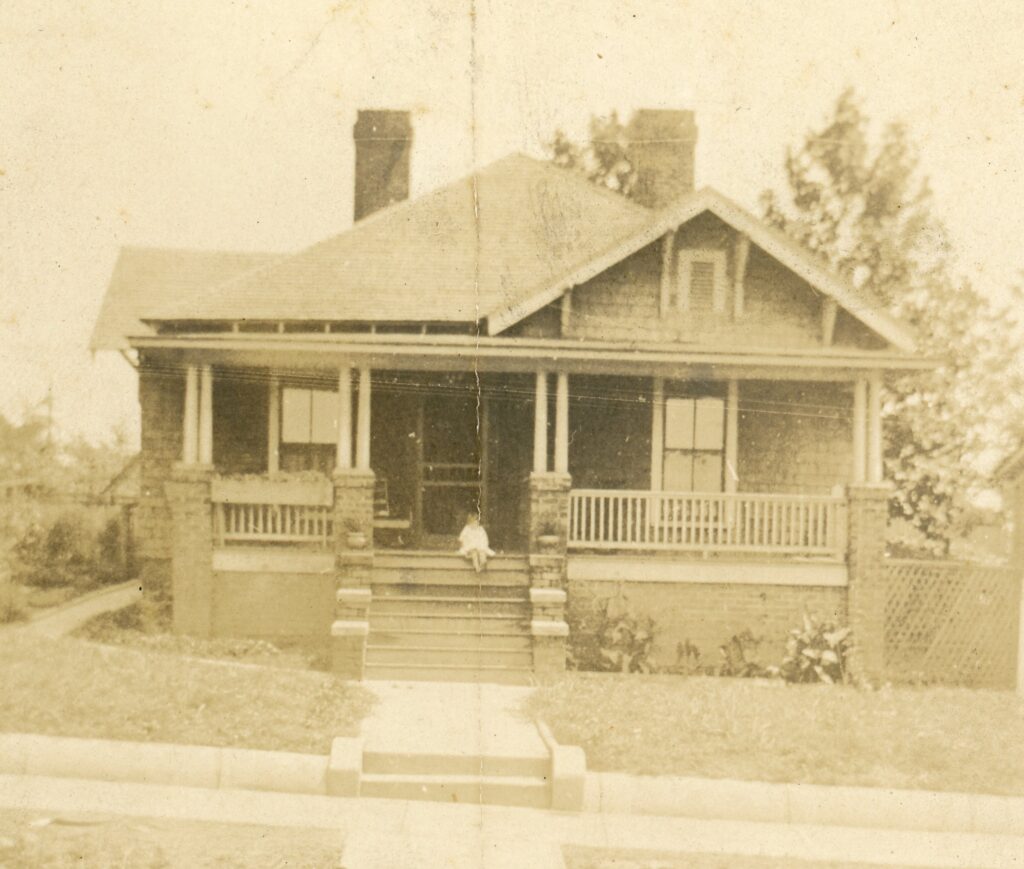
Here’s the house circa 1915, shortly after it was built. That’s my mother sitting at the top of the front stairs. My brother Charlie shared with me this photo I’d never seen, giving me a joy that connects present and past.
On wintry mornings from about age 10 throughout my teens, I put on my deceased grandfather’s tattered gray-black robe, with the torn black piping hanging loose, and pressed my butt and back as closely as possible to the radiator in the dining room. Ah, that exquisite feeling of that hot radiator warming my shivering body!
I often ate my bowl of Grape-Nuts Flakes standing there, enjoying the sweet taste of the cereal and milk alongside the warmth radiating onto my body.
When I remember and envision myself standing there, I’m alone and enjoying the early-morning solitude in our crowded little house.
I also remember all the family who lived there: my grandparents, parents, sisters, brother and me. Only my brother and I are left on this earth.
So as I meditate this December morning, I’m both being in the present—as best I know how—and remembering cherished memories from the past, connecting heat, robes, warmth, comfort, solitude and family.
REMEMBERING
I remember standing next to that radiator because the experience had significance for me, and because I kept the memories alive over the years by going back over them in my mind.
In order for me to remember, I had to pay attention at the time of the event. We’re aware at the fringes of our perceptions of a vast world of sounds, colors, smells, taste, touch, feelings and thoughts. Out of all these we focus on—pay attention to—a small portion of these. As I write these words, I am paying attention to my computer keys and screen, and I’m aware of much more to which I now turn my attention: warmth from the heater, a feeling of both excitement and also concern that I’ll be able to write something coherent and worth reading.
Of what we pay attention to, we’re most likely to remember what has significance for us. Our lives can be seen as a search for significance, whether via power, importance, myths, money, love, accomplishments and/or knowledge, and more. In looking for meaning, it’s part of our nature to consider the past and envision the future.
“A natural history of human beings would include facts about human nature, of the kind that would be found in a natural history of cacti or cats. The cactus needs warm weather to survive. A kitten is born with closed eyes. The human adult has 32 teeth. But we humans are metaphysical animals. We dwell in the past as well as in the present. ‘You should be ashamed,’ ‘We are very proud of you,’ ‘What you did was brave,’ ‘You must say sorry.”[2]
Thinking about the past is natural for us “metaphysical animals,” and can be good for us. I remember that last time this road had very slow traffic at 8:30 a.m., so I search for a better way.
We don’t just think about, but also “dwell in the past as well as in the present.” If we remember past actions or failures we regret, we can use that memory to focus on doing better in similar situations. If we remember significant times that were valuable, we can get deep satisfaction from that memory and act accordingly.
PROBLEMS WITH OUR TIME ORIENTATION
On the other hand, it’s all too easy to live in the past. Uh-oh, is that what I’m doing- –living in the past — in writing this essay connecting present and past? It’s possible.
The answer is, I think, “It depends…”, depends on what I’m doing with the rest of my time.
We need to organize ourselves by developing strategies for a healthy time-orientation.
There are a number of ways we can go wrong. In some situations, we may need counseling. In others, we can talk with friends and work on ourselves. Here are some problematic time-orientations, along with suggestions for becoming better oriented.
— We can become nostalgic for the past, blurring the edges of what was into a land of Eden from which we have been expelled. Suggestion: Be aware, and be honest with ourselves. Remember the negative aspects of the past, such as a parent’s alcoholism, frightening conflict within the home, our fear of not being accepted by peers, etc.
Be kind to others who seem to be stuck in the past, sometimes at the expense of the present. I remember driving my aging aunts around Charlotte to see the Christmas lights, and their conversation was much concerned with change and loss from the past. “Oh, the McNair family home used to be there! It’s so sad that is gone!”
Or was it I who diminished the present by silently judging my aunts? In my thirties and forties, I didn’t really understand their feelings. Now I do.
— We can become tormented by the past, through regret for our actions or anger toward someone who harmed us, perhaps in horrible ways, OR
— We can live in debilitating fear of the future.
Suggestions. We might learn about and practice cognitive-behavioral therapy, the basis of which is the philosophy of Stoicism. See my post on Epictetus and Stoicism. A key is to understand to our core that “Some things are up to us and some things are not up to us.” Such a simple idea, and yet mastery of living it can take a lifetime.
— We are “so busy” that we don’t have time to be in the present.
Suggestion: Carve out some time for Centering Prayer or meditation, perhaps as described my essay, “Seeing the World as New.”
In all these situations, we would do well not to be too harsh on ourselves. We must extend to ourselves the kindness we would grant to others.
A Healthy Time Orientation
A mentor can help. Here’s an example of a healthy time orientation.
A few years ago, I wrote about “A Wise Woman,” our friend Flo Glasgow Vaught. At age 94, she stayed in the present — avoided being stuck in the past — through a morning meditation of reading insightful books and writing in her journal. Flo’s morning meditation strongly influenced the practice of my wife Kimberley and myself.
Throughout her life, Flo read and searched for the elusive answers to the big questions of life, and she hosted groups of younger people at her house, including a group of women who explored their dreams.
Flo had clear and dear memories of the past, as well as sad ones, but she was grounded in the present and thought about the future. She and the dream group read about and envisioned a church of the future, connected with the earth, where church members would work a plot of land on which they could grow vegetables and flowers. On Sundays, the group planned to worship in the greenhouse space.
FINALLY…
Be grounded in the present, while acknowledging the importance of the past and future.
This essay is a work in progress. I’ve shared with you “… pictures, stories, theories, words, signs and artworks that help us to navigate our lives together… [in order to] at once show us what is and was the case, and at the same time suggest new ways of going on.”
I’d like to hear what you think about all this. Where are you in your time orientation? What issues do you face? How do you organize yourself to achieve your own significant life?
Click here to post a comment on my website.
To send a comment directly to me, write no*************@***il.com
___________________________
[1] Clare Mac Cumhaill & Rachel Wiseman, Metaphysical Animals: How Four Women Brought Philosophy Back to Life (New York: Doubleday, 2022), xiii – xiv.
[2] Metaphysical Animals, 282.


test
Norris, as usual your excellent post raises some interesting questions. Meditating reminds me of how hard it is to stay focused on being in the NOW, when my present keeps linking me to my past and to my future!
A recent article in Neuroscience News explores how memories are not fixed files but instead are reshaped each time we recall an event. As we meditate in the present, we process our past in the current context, and thereby update our version of the original event, hopefully with an improved understanding.
https://neurosciencenews.com/episodic-memory-change-30022/
So now instead of fighting the tendency for my past and future to enter my mindful meditations, I will see the process as one that helps me sort out my memories, remove some of the distortions, and to learn from my experiences, preparing the way for better future decisions!
Wishing you a new year filled with good memories, new discoveries and new insights to share with us! 😊
Rebecca, thanks so much for sharing your thoughtful comments and reflections, as well as the helpful link about memory. The latter corroborates and adds further support to what I read in the book Remember, by Lisa Genova.
I always appreciate your good insights. Best to you for a wonderful New Year!
Quite a bit to think about here, Norris. Remembering the past is constant in my life. It seems small activities, like brushing my teeth, can bring me back to a time in my life that did not seem very significant at the time. Why does that come back into my mind? I wonder if the emotions we feel at the time are impacting what we remember? Are we remembering the activity or the emotion?
Meditation seems to be an important way for you, and Flo, to connect to the present. As I embark on a life of retirement, I hope to meditate more – by that I mean more deeply – so that I can experience the present more fully. It takes commitment as much as the will to connect to the present.
Looking forward to the next installment. This one was excellent.
Ike, thanks so much for your kind comments and for your good reflections, which are prompting me to continue my own thinking on the topic: “Remembering the past is constant in my life. It seems small activities, like brushing my teeth, can bring me back to a time in my life that did not seem very significant at the time. Why does that come back into my mind? I wonder if the emotions we feel at the time are impacting what we remember? Are we remembering the activity or the emotion?”
Some of my journals over the past 56 years have begun with a quote from something I read. This year it was Friedrich Nietzsche who wrote,
He who has a why to live can bear almost any how.
Retirement was a time of promise to keep moving forward, to revel in this new reality, far from the madness of deadlines and crises. I could not understand stories I heard of those who were bored in retirement. It was not uncommon to find myself feeling that there was not enough time in the day to get everything done that I wanted, but that became a joy rather than angst.
Moving forward also meant motion without motion…moving forward through sitting still while the mind remained in motion. My own meditations would take place outside on our porch or deck whether it was sunny, rainy, snowy or even stormy. Our property is more rural with about 3 acres, much of which is wooded. I have cultivated a community of birds and have welcomed the families of deer that are constantly wandering through the yard usually growing in number as they year progresses and culminating in December when 12-17 will show up. It is easy to quiet the mind with birdsong, the running of the squirrels up and down pine trees, and the quiet passage of deer along their grazing route.
No matter how busy I kept myself in my retirement years (now 12 years and counting), there was always time to reflect upon the journey I had taken, and as those retirement years rolled along, I started gathering the memories of youth and adulthood through past journals as well as home movies our family had, some dating back to 1948. The Covid year of 2020 provided an opportunity to organize it all.
But with that, I confess that have idealized the past by feeling that the life of my youth and young adulthood was better than where the world is today. I struggled with regret of roads not taken, and in my promise to stay busy, I would sometimes forget to allow myself to be still.
All this has been an exercise in answering the why I am now and determine how I will continue. I have spent a significant amount of time with my faith as a Christian that has been integral to my renaissance during these senior years, and I am remembering a time shortly after graduating high school when I visited a church with a friend where I ran into a high school friend who posed that common question of the time, “Have you been saved?” The question took me by surprise, but I managed the response, “No, but I’m working on it”. Years later during our Seekers small group study at my current church, I shared this story, and an ex-Methodist minister said, “That was a good response, because honestly, you aren’t truly “saved” until you finish living”.
My journey is not finished, and the work to smooth out the rough edges will continue, but there is a lot more peace and joy now, but I will always be a seeker and a wanderer. Those are my thoughts on this, Norris. Thanks for posting…I was missing your blog.
Gary, thank you so much for sharing your fine insights about your own forms of meditation. Your keeping a journal of 56 years is quite impressive, and I’m sure a fine way to keep your memories grounded and of recalling events and thoughts that occurred to you over time. Sometime when I look back at my own journal entries, I’m quite surprised by memories I’d forgotten or I currently remembered somewhat differently.
Reading this stirred something old and steady in me. It slowed me down in a way that felt bodily, almost involuntary. I found myself back in Charlotte, beneath tall trees and in my great-grandmother’s dusty attic, surrounded by old things, books, and quiet relics of her past. It was there (in Bace’s house) that I learned to read, and more importantly, to orient myself morally, to understand that words, time, and attention mattered. The past arrived not as nostalgia, but as recognition, a reminder that who I am now, and why I’ve devoted my life to education, arcs directly back to those early moments of presence, patience, and care. This piece captures something essential about how memory and attention do not pull us out of the present, they deepen it. Thank you Norris, for honoring the way lived time forms us long before we know to name it.
Nate, thanks so much for your encouraging comments and your own thoughtful meditation about the past and what it means to you. Those specific memories you share well exemplify your insight that, “The past arrived not as nostalgia, but as recognition, a reminder that who I am now, and why I’ve devoted my life to education, arcs directly back to those early moments of presence, patience, and care.”